
The ASQ calculator is a free online tool designed to help parents, educators, and healthcare professionals determine which Ages and Stages Questionnaire (ASQ) is appropriate for a child based on their exact age. This developmental screening tool simplifies monitoring a child’s progress across key areas, including communication, motor skills, problem-solving, and social-emotional development.
Calculate your age or the age difference between two dates.
Provide the date of birth and optionally the date to calculate age as of.
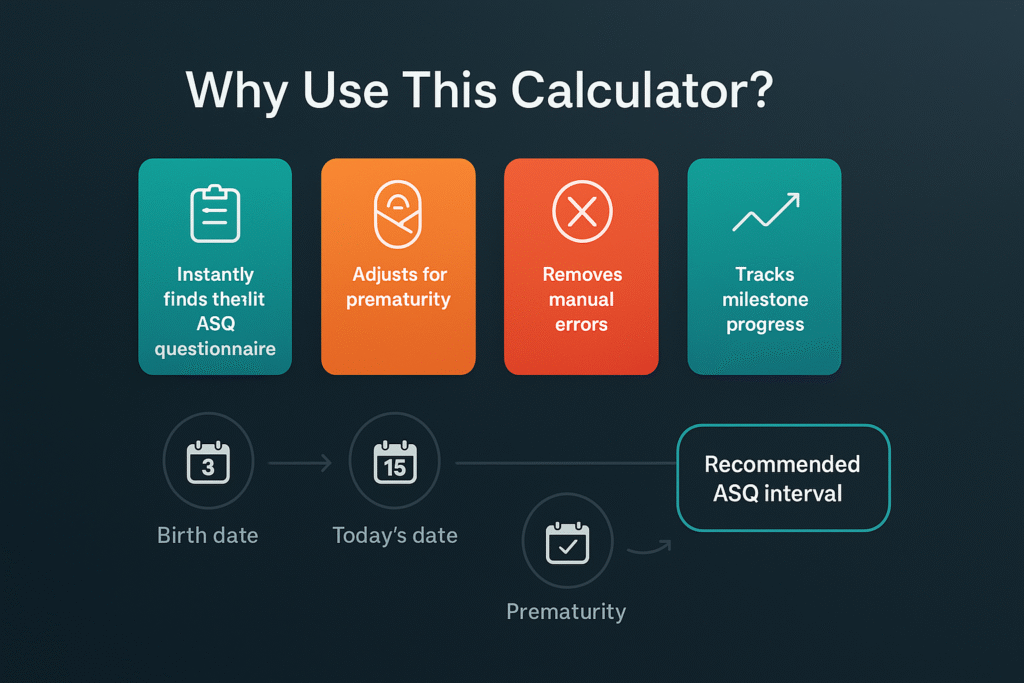
Child’s date of birth
Current date or planned screening date
Weeks of prematurity (if applicable)
Recommended ASQ questionnaire interval
Chronological age in months and days
Adjusted age for premature infants (when under 24 months)
Example Calculation: A child born on March 15, 2024, screened on October 9, 2025, would be 18 months and 24 days old. The calculator recommends the 18-month ASQ-3 questionnaire. If the child was born 6 weeks early, the adjusted age would be approximately 17 months, suggesting the 16-month ASQ for accurate developmental expectations.
When you use the ASQ calculator, you receive specific guidance on which questionnaire to administer. Here’s how to interpret and use this information effectively.
Language understanding and expression.
Large muscle movement and coordination.
Hand and finger coordination skills.
Learning ability and cognitive development.
Self-help abilities and social interaction.
The adjusted score feature ensures premature infants are compared to appropriate developmental norms, not penalized for early birth.
Gather Information: Have your child’s exact birth date ready, including any prematurity information from medical records
Enter Data: Input dates accurately into the calculator fields
Review Results: Note the recommended questionnaire interval and both age calculations
Obtain Questionnaire: Access the appropriate ASQ-3 form through your healthcare provider or authorized source
Complete Screening: Answer questions based on your child’s typical, current abilities
Interpret Scores: Review results with your pediatrician or early childhood professional
Use the calculator before each screening to confirm you have the correct questionnaire
Complete questionnaires when your child is healthy and well-rested for the most accurate representation
Answer based on what your child consistently does, not one-time occurrences
Store results to track developmental progress over time
Share results with all caregivers and healthcare providers involved in your child’s care
Communication Development: This domain assesses how children understand language and express themselves. Questions cover babbling, word usage, following directions, and sentence formation appropriate for each age stage.
Social-Emotional Growth: Social-emotional questions evaluate how children interact with others, show affection, demonstrate independence, and regulate emotions—critical components of overall child development.
Motor Skills Assessment: Both gross motor (running, jumping, climbing) and fine motor (grasping, drawing, using utensils) skills are evaluated using age-specific questions that reflect typical developmental milestones for each month interval.
Yes. Our online calculator is mobile-friendly, and results can easily be accessed through your browser
Regular developmental screening is recommended at 9, 18, and 30 months of age during well-child visits. However, screening at every visit provides the most comprehensive monitoring of developmental progress. Use the age calculator to determine which questionnaire to administer at each interval.
Chronological age is calculated from the child’s birth date. Adjusted age accounts for prematurity by subtracting the weeks born early. For accurate screening, children under 24 months who were born more than 3 weeks premature should use adjusted age when selecting ASQ questionnaires.
The standard ASQ-3 covers children up to 66 months (5½ years, 6 months). For older children, different developmental screening tools are more appropriate. Consult with your pediatrician or school about age-appropriate assessments.
No. The ASQ calculator ages and stages tool is specifically designed for developmental screening. A metabolic age calculator assesses fitness and body composition, while a USSSA age calculator determines youth sports league eligibility. Each serves a distinct purpose.
ASQ questionnaires are available through your pediatrician’s office, early intervention programs, or can be purchased from the official Ages and Stages website. Some healthcare systems offer ASQ screening through their patient portals or mobile app store applications for convenient access.
When it comes to screening young children, the ASQ demonstrates strong reliability and validity. However, it’s designed as a screening tool, not a diagnostic instrument. Scores below cutoffs indicate the need for further professional evaluation, not a definitive diagnosis.
Use our free ASQ calculator above to determine the appropriate questionnaire for your child’s developmental stage. Regular screening with accurate, age-appropriate tools helps identify children who may benefit from early intervention services, ensuring every child reaches their full potential.